

Guided by belief but not yet by practice: study reveals 'good intentions but significant gaps' in FCI

Updated: Jun 23
Press release: 30 April 2026:
Faith-based organisations manage trillions of dollars in investments with the potential to shape markets and drive positive outcomes – but much of this potential remains unrealised.
This is the central finding of international non-profit FaithInvest’s new research publication, Good Intentions 2026, a landmark global study which examined 275 publically available faith-based investment policies to asses how faiths translate their beliefs into investment practice, and where significant gaps remain.

That is a central finding of international non-profit FaithInvest’s new research publication, Good Intentions 2026, a landmark global study which examined 275 publically available faith-based investment policies to asses how faith-based organisations translate their beliefs into investment practice, and where significant gaps remain.
The report finds that while many faiths demonstrate a clear commitment to investing in line with their values, most fall into “a ‘basic effort’ tier when it comes to their investment policies”, said FaithInvest Executive Chair Dave Zellner.
Most have yet to fully integrate their values into how capital is allocated, managed, and monitored. Nearly 90% of organisations scored below 30 out of 50, with none reaching the highest category, indicating full alignment between faith and finance remains rare.
A first-of-its-kind global benchmark
Good Intentions 2026 is "the most comprehensive, evidence-based assessment to date of how faith values are embedded in investment decision-making", said FaithInvest Programme Manager Catherine Devitt, co-author of the report alongside Dave Zellner.
"It also provides important insights for the wider investment ecosystem – including asset managers, advisers, and service providers – highlighting where better products, advice, and support are needed to help faith investors achieve deeper alignment."
The report analyses 275 publicly available investment policies and guidelines – providing the most comprehensive, evidence-based assessment to date of how faith values are embedded in investment decision-making.
Our FCI Assessment Framework
At its heart is FaithInvest’s Faith-Consistent Investing (FCI) Assessment Framework, which evaluates how organisations articulate faith alignment across 10 core areas of investment policy – from foundational beliefs and screening approaches, through to governance, portfolio construction, and ongoing review.
Each organisation is scored out of 50, creating a consistent and comparable benchmark across traditions, geographies, and institutional types. By focusing on what is formally set out in investment policies and guidelines, the report provides a clear view of how faith commitments are translated into investment practice – and where they are not.
Progress – but a long way to go
The 104-page report highlights several important patterns shaping the current state of faith-based investing:
Most organisations remain at an early stage: Nearly 90% of organisations scored below 30 out of 50, with none reaching the highest category, indicating that full alignment between faith and finance remains rare.
Avoiding harm is more developed than creating good: Negative screening (excluding harmful sectors) is common, but far fewer organisations are actively directing capital toward positive social and environmental outcomes.
Governance is relatively strong – but often disconnected from faith: Many institutions have robust oversight structures, yet these are not always explicitly linked to their faith commitments.
A ‘missing middle’: The sector is characterised by a large group at early stages and a smaller group of more advanced practitioners, with relatively few organisations in a strong middle tier.
Enabling architecture is needed: Organisations that perform more strongly benefit from established networks and support structures, while many others lack the infrastructure needed to operationalise faith-consistent investing – highlighting the need to strengthen the wider ecosystem of products, advice, and collaboration.

From intention to implementation
Commenting on the findings, FaithInvest Executive Chair Dave Zellner said: "Faith-consistent investing is often still understood in terms of what organisations avoid.
"The data shows that while exclusion policies are relatively well developed, there is much less clarity on what organisations are actively seeking to support, and how faith commitments are embedded in governance and decision-making.
"There is enormous untapped potential in faith-based investing. Realising it depends not only on organisational commitment, but on access to the right structures, expertise, and support – and too many still lack the architecture needed to translate intent into practice.
"Closing the gap between faith commitments and investment practice will require action from across the system – from trustees and investment committees to asset managers and advisors. This is not something any one actor can solve alone."
A practical tool for change
Good Intentions 2026 is designed not only as an assessment, but as a practical tool for change. It enables faith-based organisations to:
Understand where they currently stand
Identify clear, practical areas for improvement
Strengthen alignment between faith values and investment practice
It also provides important insights for the wider investment ecosystem – including asset managers, advisers, and service providers – highlighting where better products, advice, and support are needed to help faith investors achieve deeper alignment.
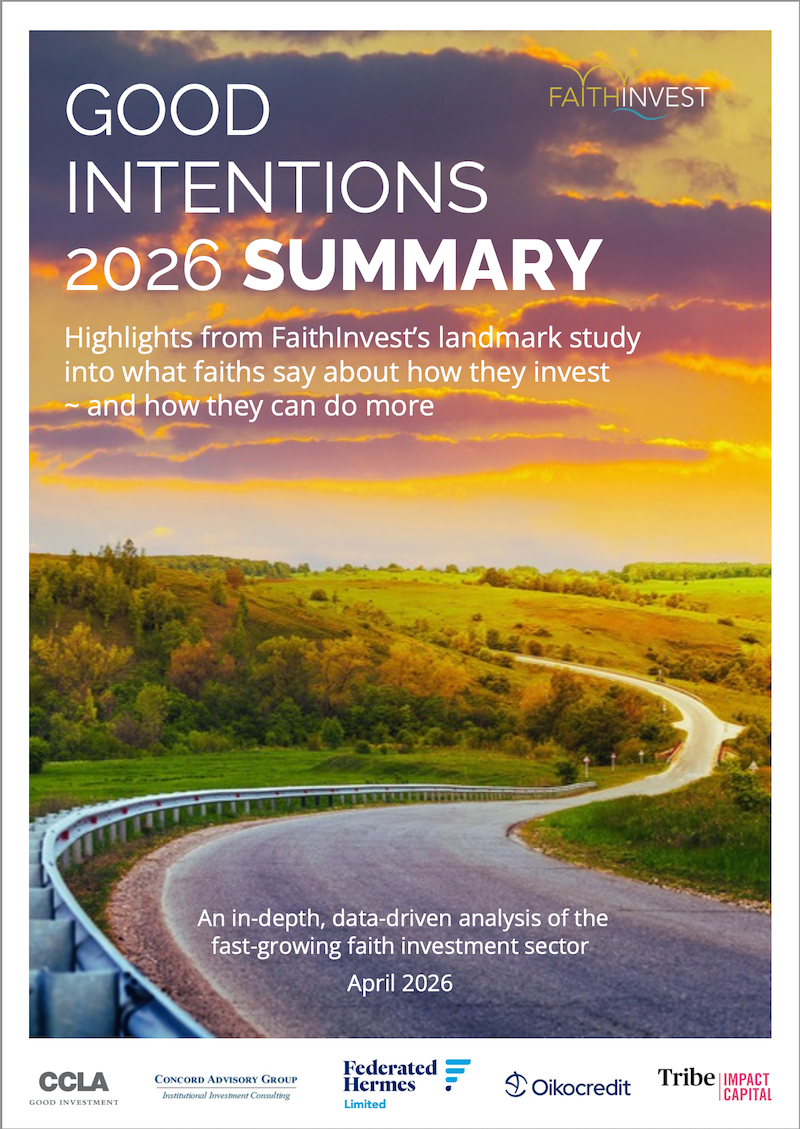
Access the full 104-page report here or download a 12-page summary below.
Online global launch: Wednesday May 6
The report was launched at the Faith in the Common Good international faith-consistent investment Forum in Paris, which convened faith leaders and investment decision-makers from around the world to explore how capital can be mobilised in service of people, planet, and the common good.
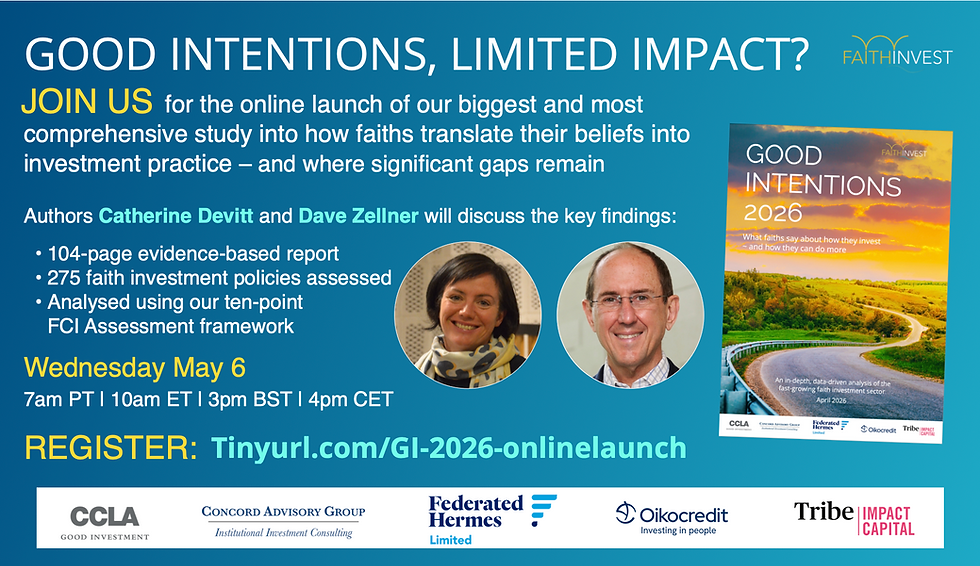
We are holding a global online launch of Good Intentions 2026 on Wednesday May 6. See below for details and scroll down to register.
A collective effort to strengthen the field
The report was made possible through the support of leading organisations across the investment sector, including Lead Sponsor Federated Hermes Limited and supporting sponsors; CCLA; Concord Advisory Group, Oikocredit and Tribe Impact Capital.

