

'AI needs to be a top priority for faith-consistent investors,' say speakers in our special webinar

Faith investors must work together as a unified group if they are to stand any chance of influencing the development of artificial intelligence for the common good. That was a key message from FaithInvest's special forum last week on faith-consistent investors and AI, writes FaithInvest's Susie Weldon.
AI is moving faster than we – or our ethical frameworks – can keep up. How are faith-consistent investors responding to AI, and what should they understand about the key risks and responsibilities generated by this new technology, which is set to transform all our lives?
This was the topic of FaithInvest's special webinar on artificial intelligence, which had a panel of speakers who are all on the front line of grappling with issues arising from AI. They included:
Barbara Ridpath, chair, Church of England's Ethical Investment Advisory Group;
Umer Suleman, Chief Risk Manager for Wahed, an Islamic fintech company, and a board member of Islamic Finance Council UK;
Josh Zinner, CEO of ICCR (the Interfaith Center on Corporate Responsibility), a coalition of more than 300 institutional investors, including many faith groups.
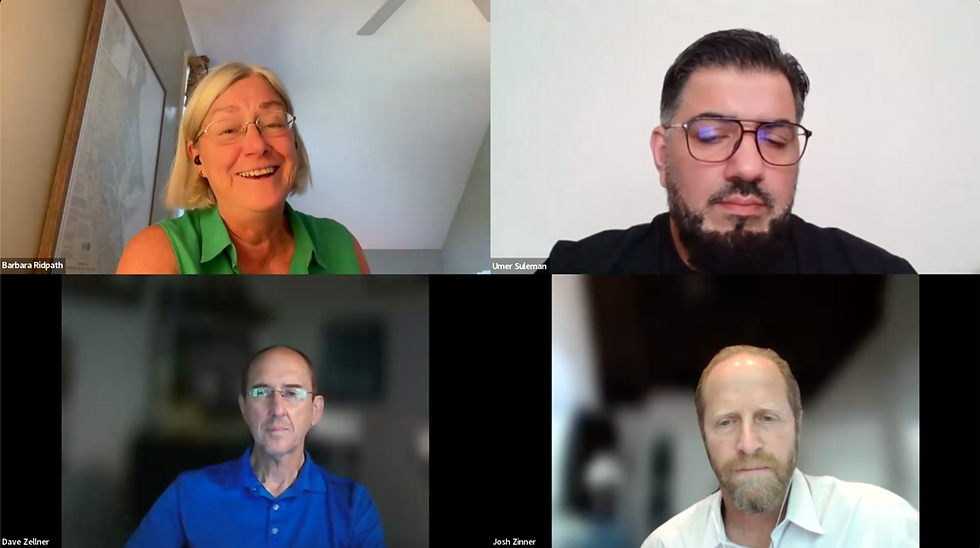
Setting out the aims of the forum, FaithInvest Executive Chair Dave Zellner said he hoped to address why faith investors should engage on issues around artificial intelligence; the risks that companies face in deploying AI and how they conflict with faith values; and what investors should do now.
Risks and unknowns
Josh Zinner said AI was driving the economy: 'It's here to stay. It's going to take over many aspects of our lives.' There would be many benefits, he added, but there were also substantial risks and unknowns.
That's why AI needed to be a top priority for faith investors: 'Not just to talk about the long-term risks, but also to focus on the risks that are right in front of us,' he said. 'The risks to the future of work, around autonomous weapons and surveillance, around privacy, around discrimination – issues that are of deep concern to us as faith-based investors.'
He said a key framework for ICCR's work was the UN guiding principles on business and human rights in our engagement with companies. 'And that's critically important in engaging with the tech sector and with developers.' Another important framework was Pope Leo's encyclical Magnifica Humanitas, which puts a focus on the dignity of work and the human person.
A moral hazard
Umer Suleman explained how using an Islamic faith lens in investment decisions helped to focus on the intent, or purpose, behind the use of a particular technology. 'It asks the question: What is the ultimate purpose of this technology? What are the unintended consequences of it as well?' he said.
'So that faith lens helps us to look at it from a more balanced perspective. And then there's also this element of active stewardship over passive screening. A faith lens inherently rejects moral passivity.'
Explaining further, Umer Suleman said one of the big risks with AI was the opacity with which the models are developed: 'Even their creators can't always explain how they reached a specific output, and they're constantly learning.
He added: 'This becomes a problem when these models are used to determine, for example, credit worthiness, insurance premiums or automated financial trading; we're introducing systemic, unquantifiable guidance into the economic system and we don't know how these rules are actually being based, or what they're derived from.
'And so then this also creates a moral hazard of automated accountability from a risk and compliance perspective, which is my day job, so to speak. If you can't audit the logic behind a decision, you can't actually establish accountability. As faith investors, we have to refuse to outsource moral responsibility to unaccountable black boxes.'
Influence the users
Barbara Ridpath made the point that many of the developers remain privately owned, which makes them more difficult to influence. 'For this reason, it's important to consider investment positions not just of the developers, but also the users who are paying increasing amounts of money to access these systems,' she said.
'How they use it in pursuit of their own corporate goals has to be part of our influencing strategy. Ultimately, we can have as much more influence by working with the customers of AI as we can with the developers directly.'
In addition, faith groups such as the Church of England and the Catholic Church have a convening power to be able to influence well beyond the ownership of its shares, she said: 'And I think it's really important to use that as well, because we have traditionally had an influence beyond the monetary value of our investments.'
Could divestment be an answer for some faith-consistent investors? While some faith-based investors were taking action to divest from companies whose ethos differs from their own, this was a tricky issue because of the dual use of much of this technology, said Josh Zinner.
Many of ICCR's members followed a process of engagement with companies to address their concerns, but if there wasn't progress, they would consider a responsible exit.
Next steps
Dave Zellner asked the panellists to outline the next steps faith-consistent investors should take, if they'd not yet taken any action on AI. Here are some of the suggestions from the panel:
Create a unit or an ethics board that focuses on evaluating AI tools on how they are being built and whether they promote human flourishing or exploit human vulnerabilities, and ensure the board has the capacity to do this (Umer Suleman)
Take part in webinars such as this one, read the Pope's encyclical Magnifica Humanitas and talk to your asset managers to understand how they are engaging with AI companies (Barbara Ridpath)
It's critical to engage with your asset managers, added Josh Zinner. He suggested the following questions to ask them:
What is your policy for evaluating AI-related resolutions? You don't want to hear that it's case by case or that they don't have a policy. You really want an asset manager who's thinking deeply about this
How does that asset manager in its stewardship identify an investment, identify AI material risks?
How do you incorporate as an asset manager a human rights framework into your proxy voting?
What types of AI proposals would you support? And you certainly don't want to hear that that's heavily weighted towards management.
What AI expertise do you use as an asset manager to inform your voting and stewardship?
How do you evaluate board oversight?
You can watch the webinar on our YouTube channel by clicking the image above. You can also download a transcript of the conversation below. You can also download a transcript of the discussion below:


